Thursday, December 8, 2011

Hungarian Battle Wounds


Lying with my face buried in the crook of my elbow, I’m trying to simultaneously block the harsh hot light emanating from the round medical lamp and ignore the doctor/surgeon’s feeble attempts to make me concentrate on something other than the excruciating and disgusting sensations I’m feeling as he digs around in my leg (“So how old are you?” You really think that’s going to help right now?!). My stomach starts to churn as I wonder what the fuck exactly was I thinking when I decided this was a necessary—even beneficial—decision. My thought is interrupted by a sharp, deeply penetrating pain, followed by a heavily accented exclamation, “It was glass!”. My knee has given birth to a long, shiny sliver of glass, and I want to puke.
Though the doc asked if I wanted to keep the piece of glass as some sort of sick souvenir, I have no pictures of it and it is no longer in or anywhere near my body. Also note the awesome bandage cross mark.
What brought me to this fateful moment lying on the iodine-stained operating table in The-Middle-of-Nowhere, Hungary, you ask? About a year and a half ago, my ex-boyfriend and I found ourselves locked out of his house. We had to climb through a broken window to get in, and, after perhaps a couple of beers, I didn’t notice I’d gotten stuck by a large shard from the window until a small stream of blood had appeared down my leg a little while after we’d made it back inside. I fearlessly yanked at it and got most of it out, didn’t find it too worrisome at the time that there might still be glass in there, and promptly PTFO’d. The next day, in my morning-after haze I somehow twisted my memory to conclude that it was a wooden splinter from the window frame that had gotten lodged in my leg. A week later I could still feel the “splinter” inside of me and I asked my family doctor if I could get it taken out. She said not to worry, that my body would eventually take care of it.

So, a year later—this past summer—I had almost all but forgotten about it. Until, that is, I banged my knee the wrong way somehow and it had been periodically bothering me ever since. But over the past month, with the drop in temperature and frequent walking/running/roughhousing with kids, the pain had become excruciating. If I took a particularly heavy step or so much as grazed my other leg against it the wrong way, it felt like someone was stabbing me from my knee down to my foot. Out of desperation, or perhaps more out of frustration, I set my mind on making the first trip to the hospital in my life, in Hungary no less, where public services are chronically underfunded and almost no one speaks English. Excellent.

The building was pretty nondescript, the only hint that it was a hospital was the sheer size of it—it was mammoth. I walked into the nearest entry because it was cold out and I wanted to ascertain whether or not this was the place I was looking for. “Beszél angolul?” Of course, the two security guards spoke absolutely no English, but they assured me that I was in the right place, and one of them was nice enough to walk with me to the pharmacy where one of the pharmacists spoke English. After explaining to her my situation, she told the guard where to take me and he left me with the woman at the reception desk of the emergency room, who also spoke not a single word of English. Thankfully within a few minutes a doctor who spoke perfect English came to help input my insurance information and I took a seat in a creaky wooden chair in a row of crowded wooden seats. As I went to sit I eyed a rotund old man with the messiest, most pathetic attempt at a leg cast I’d ever seen, and I thought that this did not bode well for me. The lights were only half on, barely enough to cast a shadow in the icy beige hallway. Elderly people with faces that looked like burlap sacks stuffed with potatoes were rolled past, their vacant stares meandered. The ambulance crew pushed a decrepit old man down the hallway in a wheelchair. One of his feet had come dislodged from its proper platform, so that as he passed he made a clean, steady squeaking sound across the floor. His eyes were empty. I was seated next to a row of people who all had their left arm in a cast. It seemed like they’d all been in the same accident, but I could draw no possible commonality amongst them to support this supposition. People in white coats occasionally stepped out of the line of doors in front of us to announce names. When mine was finally called, it was extremely obvious that it was mine because it didn’t sound like mush coming out of the doctor’s mouth.

I stepped into a sterile hybrid of an examination room and a cubicle. One of my examiners spoke some English, the other spoke maybe three or four words. After I explained my problem, they each took turns jabbing their index fingers into the side of my knee. They were genuinely confused as to why I was coming to them. “Why don’t you just wait until you go home?” But I was determined. “Well, the only thing we can do for you is surgery.” “I just want it out,” is all I said. And that was that.

A woman (who of course also spoke not a word of English) led me to an impossibly even more depressing hallway and pointed at a door vigorously before pointing to another row of wooden seats vigorously. I sat down and dissolved into the shadows.

Maybe it was the sudden rush of anxiety following the realization that I was about to have someone cut into me, in a place where almost no one could understand me, with no one but the dazed burlap faces to accompany me, but some deep fear started to consume me and my heart began to race. As I generally react to stress by becoming drowsy, I began to roll in and out of consciousness with my head cocked to the side leaning against the cold beige tiles. I heard screams of children, the recurrent noise of a saw. Under the hideous pale blue florescent light, doctors walked with trays carrying mysterious medical samples down through a faded red gate down a flight of stairs that presumably led to the underground torture chambers. Dazed, I laid back on the row of chairs. My phone fell out of my jacket pocket. After abandoning my attempts to pick it up because my arms were too short, an older, fatherly man knelt in front of me and gently passed it back to me. He said a few things in Hungarian, and when all I did was return him the expression of pure, innocent confusion that I imagine his six year old daughter gives him as he tries to explain to her one of life’s great mysteries, he repeated himself again. Coming to, I finally mustered up “Nem beszelek magyarul.” All he did was put his hands on his knees to rise and sigh as he said wistfully, “Nem beszéls…”

I had just gotten to close my eyes and find some peace when I heard the magic door creak and “Baker Kelly Anne” roll uncomfortably off the assistant’s tongue. I took a deep breath.

Monday, November 7, 2011

A Day in the Life

Our house in the camp is pretty nice. I sleep in the living room on a very, very hard bed (I sleep on top of a comforter for a little extra cushion).
Clearly, I've taken over...


My main complaint is about the washing/drying appliances:

The washer is a bucket with a wheel for churning the water, the dryer is a bucket with holes that spins really fast to suck out the excess water in the clothes, so to completely dry I put the clothes on top of the radiators and turn the heat up all the way. This whole process takes at least an hour.
Morning outside my house (the blue-green one)

A typical day for me starts around 7, when one of us gets up to fetch breakfast. The mornings are peaceful, but a bit eerie: cold and bright, always with the scent of smoke wafting through the air.
Just another frosty, creepy sunrise

Breakfast generally consists of a beverage and some salami/bologna/mystery meat with a ton of bread and margarine. One note about the food here: we always have a ton of bread at every meal. Then I shower and eat, preparing for the English lessons at 10. On alternate days I teach intermediate English to one or two men, one of which is very enthusiastic about Canada, and beginners English for women. The classes are split this way because the Afghani women cannot be in the same place with Afghani men who are not their husbands.
The Red House where we work

After teaching for an hour or so, lunch is served at 11:30. Laurie and I eat with the other employees in a separate dining room from the minimalist cafeteria for refugees. For many Hungarians, lunch is the big meal of the day, so it always starts with a soup of some kind, followed by a main dish of (very oily) meat accompanied by rice/potatoes/pasta and a side, usually pickles, paprika (which I've found many other countries call bell and hot peppers) or cabbage. Often there is some sort of dessert as well, but lately the camp has been in a questionable financial situation, so dessert is much less frequent and breakfast is also much more bare-bones. While the employees have the option of choosing from menu A or B, we are always served A, so of course, B is always nicer. Menu A is also what the refugees are given. That being said, it's not terrible, just not great. After the meal, we are given our "dinner." Now, as I just noted, the lunch really ain't so bad. What they call dinner is, again, an assload of bread with cans of, well, any rational human being would call it cat food: chicken or beef paste or fish something, as well as juice boxes, what I can only think to call smooshy tubed cheese, and yogurt.
Thus, I usually take away leftovers from lunch, improvise from there, and give the food in the cans to a black cat that comes around every morning. One of my favorite treats is a slice of buttered bread toasted in a pot (we only have a microwave, stove and a pot, no toaster or oven) with some jam on top. I actually crave it sometimes and get really excited just thinking about making it. Yup.
Our canned cat food collection & some candies...

Our well-equipped kitchen

After lunch, we have free time to nap, read, or use the internet in the NGO (Menedek) building.
We open the Red House again at 1 or 2 for children, who run around screaming and fighting for a few hours. Their favorite things to do are breakdance to the same 3 songs (carry up timbaland, promiscuous girls, and a rap song in Albanian that one of the kids here recorded) and color. Once I made the mistake of letting them play with my phone camera and this photoshoot ensued:

After the demons have cleaned and cleared out (if they haven't already been kicked out for misbehavior) adults come for a small variety of classes—Hungarian, film club, Zumba, stretch—all of which are sparsely attended. Our supervisors here encourage us to start classes we have interests in, but the social workers we work directly with in the house often can't handle more than one activity going on at a time, so our schedule had been pretty restricted and boring until we complained last week. Now we're trying to offer more things, but progress, as always, is slow. A group of teenage guys usually comes to play ping pong and bullshit for a while and lately I’ve been offering some informal English classes for those who can’t make the morning session. By then, my mind is completely spent on having to control the children and attempt to explain minute grammatical mechanics. We close the house at 8 and head home. Sometimes we stop by some of the family’s houses to chat and get treated to some delicious tea, snacks, or baked goods. When I’m feeling up to it, I brave the frigid night air to sit outside the fifth window of the Menedek building to attempt to use the internet at a more convenient time for all you West Hemisphere dwellers. And that’s what I’m doing right now.

Friday, November 4, 2011

This isn't summer camp

Sitting in the worn out seat on the old train, I stared out the window over the sunny and desolate landscape. I had no idea what I was heading into, but was having one of those moments where you see yourself from the outside, knowing how you will look back at your imagined expectations, feeling on the precipice of realizing something you knew was coming all along. These moments are pregnant with anticipation, like a state of suspended animation. I asked my travel companion, Laurie, who I would be working and living with over the next two months, about obscure and basic information on the workings of the refugee camp, my future residence and place of work. I let my imagination wander, knowing full well that these fantasies and assumptions would probably be entirely squashed or transfigured upon my actual arrival.

Once we got off the train, I was most surprised by the city. Debrecen is the second largest city in Hungary after Budapest. Having just spent the weekend in the enormous, cosmopolitan capital, I had high expectations for the city. But driving through what I really hoped was merely the outskirts of town, I was struck by the, well, Third-Worldliness of the place. I had been shocked at how visually similar Budapest was to Buenos Aires, but when Debrecen, with its dusty lots, low-rising autoservice shops, tiny outdoor produce stands, and chalkboard restaurant menus, started to feel like a lazy Latin American town, or Mendoza.

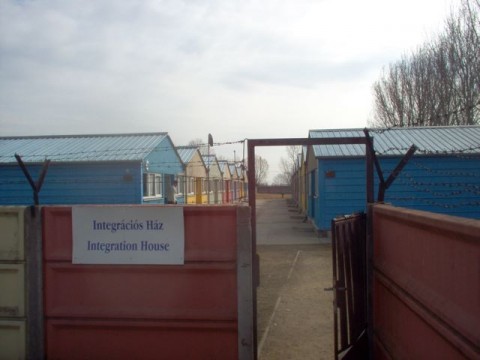
The camp is located at the edge of the city, quite literally:

The sign before the entrance to the camp
As you can see, we are surrounded by absolutely nothing.

The car pulled up to the large gate connecting a melancholically faded red and yellow two-toned barbed wire fence. The color scheme made me feel like I was about to enter into the most depressing circus in the world, and to some extent, this feeling has remained rather salient throughout my time here. The door of the van slid open, I blinked a few times as I stepped into the golden late afternoon sun, as if the sight of this foreign place was blinding. People were roaming around aimlessly; some watched with disinterested or mild curiosity from afar and others silently drew closer as I, the new arrival, clambered clumsily out of the vehicle. I followed Laurie in the direction of our home. Children ran up to her and grabbed her around the waist, adults hovered nearby to say hello and she greeted them all in what seemed to me like at least ten different languages. She hurriedly explained to me what languages some spoke and I just followed dumbly, stupefied.


Three weeks later, I feel like I have a much better handle on things, though I have accepted that I will probably be living in a state of varying degrees of confusion for the duration of my time here. As Laurie simply put it, "Here in the camp you have more questions than answers."

Saturday, October 22, 2011

First Impressions of Hungary: Getting Sauced with Sausage

So. I have finally arrived. Well, actually I’ve been in Hungary for two weeks now, but between sightseeing in Budapest and moving into the refugee camp, neither equipped with reliable Internet, I haven’t had much time. More about the camp later, but here’s a bit about Debrecen, the city I live just on the outskirts of. Last weekend I checked out the Pálinka Festival held at the main campus of the city university.
Pálinka is the national drink of Hungary that is usually fruit-flavored. Think of it as vodka is to the Russians, pisco to the Peruvians, JD to Mötley Crüe. Now, I tried some of this stuff at this awesome bar in Budapest with a group of New Yorkers, Latinas, and one local Hungarian. Let me tell you, after taking the shot, only the Hungarian didn’t have a face resembling that one.

Conclusion: This shit is worse than tequila (even the Mexican attested to this very fact). It burns allllll the way down.

So anyway, after wandering around for a while at the festival, I tried some barack (peach) and decided it wasn’t too horrible. This vendor in particular also had carrot, paprika, beetroot, and garlic varieties, supposedly for cooking purposes. The garlic really smelled like the real thing and I won’t lie, I was kind of tempted to try it (especially since it’s getting towards Halloween and I’m near Transylvania and all).

Then, since apparently pálinka and pároskolbász (sausage) go together hand in hand, I decided to grab this tasty looking number:
Mmmm, greas-aay.

This is why I don't pretend to be a foodie and take pictures of the food I consume.
And washed it down with some delicious mulled wine.

Afterwards, I walked around to take some pictures and started talking to Clara, the daughter of the Savanya Pálinkaház owner. Her mom, who didn’t speak a word of English, had been really sweet and as helpful as possible when I had taken my first walk around, and they undoubtedly had the most attractive pálinkas:

She explained to me how the liquor is made, and, as I understood it, it’s made from fermenting and distilling fruits. She encouraged me to try the meggy (sour cherry) flavor—not bad—and this fruit I had never heard of, som (cornel)—quite good, actually!
Sour cherry poison.

Then I caught the tail end of a performance by Budapest Bár. If you are at all interested in Hungarian music or what this completely bizarre language sounds like or the kooky kind of shit they’re into, take a look:

The song after this one made everyone in the place go ape shit, jumping around and throwing their hands in the air. It was a lot of fun, but I had to leave a bit early to catch a bus. Which of course I missed, so I had to sprint to the tram, run across town through the mall, where they thought I was a thief because I was sprinting with a giant backpack, to the last bus leaving the city center for my bumble fuck accommodation in the camp, which, of course, pulled up just as I was stumbling across the street. Close call!

Friday, October 21, 2011

Requisite RIFF Post

Ok, last post about Iceland, I swear.

Oddly, one of my favorite things in Iceland was going to RIFF at the cinema down the street from my hostel to see Man on Wire with a subsequent Q&A session with the director, James Marsh. Now, I know I'm late on the train for this one, but it is a spectacular film; incredibly moving and uplifting. If you haven't seen it yet, do it NOW. I'm pretty sure you can find it streaming on Netflix.


Anyway, here is a clip from the Q&A. Apologies for the off WB and shitty timing, I am way too lazy to color correct (why bother?) and I didn't think to start recording his responses til halfway through the session. Here he first answers a question about why he only used stills to portray the moments when Phillipe was on the wire and then discusses why he deliberately chose not to address the 9/11 attacks.


A very interesting talk and I wish I had more to share!

Wednesday, October 12, 2011

The Cheapy-Cheapy Life, pt 2

When trying to save money, sometimes you end up spending more. – Confucius (I’m pretty sure)


A Toyota Tragicomedy. 
Iceland is fucking expensive. Iceland is also fucking awesome (see photos). These two facts are exceptionally problematic for travelers like myself. The first excursion I went on (see photos… again) cost 10,000 kr. That’s $85 for one day of dope shit.
So, to see the “most beautiful” part of Iceland, Snaefellsnes, me and four other volunteers decided to rent a car for an estimated €30 each. The funny thing about estimations is that they can be wildly off base.
So the morning of our planned trip starts off normal enough. We have some breakfast and wait for the driver of the group to return with the car. First, let me explain the cultural background of our rag-tag team: the driver is Hadi, an insane Israeli (is that redundant?) with very, very little common sense, shotgun is Alvaro, a good natured (often to a fault) Spaniard, and the girls along for the ride: Martina, a wide-eyed German (the youngest of the group), Birgan, Turk and resident cynic, and myself, whatever I am.

We all pile into the tiny red Toyota with a questionably functional gearshift and a window that doesn’t quite fit in the doorframe, and set out in entirely the wrong direction. In the back we all get slightly squeamish at the driving techniques Hadi employs as he complains that things are not like this in Israel. We drive around for a while until we find the highway we want to get on (it is really quite difficult to get lost in Iceland, as there is really only one highway that goes around the whole island). The scenery is stunning and the weather is gorgeous. We make a brief stop to find some food, during which I attempt for the first time in my life to drive a manual car to leave Hadi behind and just end up stalling the engine. We stop to take some pictures before heading onward to meet up with the planned expensive excursion, led by an Italian man named Davide with a crazy laugh and the reddest beard I have ever seen on a non-Irishman.
We had planned to meet him and the other volunteers at the small seaside village of Arnarstapi. We find them around lunchtime and continue to follow them up the mountain path to reach the glacier. However, Hadi really had to take a picture of something stupid and completely insignificant through the filthy windshield, so we lose the large van Davide is driving. Now, this didn’t seem like much of a problem at the time, as there seemed to be only one path through the mountain. This assumption turns out to be entirely wrong, and as we drive further up into the clouds, the atmosphere becomes increasingly foreboding. The fog is so thick that you can’t see anything beyond ten feet from the car and the road seems to twist and turn to absolutely nowhere.
Finally we all think it’s taking way too long to get through the pass, so we ask Hadi to just turn around and go somewhere else. Hadi, however, decides that the best course of action is to turn down a completely random road with a sign pointing to a completely random town that isn’t even on the map. We all begin to tell Hadi to turn around, and Martina starts crying and shouting about how she doesn’t want to die up on the mountain. Hadi offers a simple solution: we can eat each other! Donner party much?
Finally, Hadi reluctantly gives up as Martina is about to have a total meltdown and I start to giggle uncontrollably as things are reaching the point of hysteria. We head back down the mountain and call Davide to find out where we can meet the group. We attempt to follow his directions to the black beach—attempt being the operative word, as Hadi cannot seem to understand the name of the town we are looking for, so I resolve to call it Dirtvik so that he will stop trying to turn down roads to towns that start with K or J. Finally we end up running into Davide and the other crew, and he points out a nice spot to go to the beach. At this point the weather has deteriorated the typical Icelandic clouds, mist, and rain, but the waves are really spectacular so we stop for a quick frolic in the waves. I think this was the highlight of the trip for me.
Then we get back in the car for more exploring and Hadi stopped by a sign that was pointing to some random and indicating that whatever it is, it’s located two kilometers away. He tries to convince us to go for a walk, which he swears will only take 5 minutes (2 km?) but at this point we’re freezing and tired and think he’s a pathological liar, but of course Alvaro offers to go with him and the two trot off together. After a while, we start to get bored and play cards. After what must have been at least forty minutes, we finally see the two of them running in our direction. In anticipation, Martina goes to start the car. Hah. Nice try.
Now, we had been listening to the radio for a bit, but that is not enough to cause a car to die. Then it hits me: the fucking LIGHTS. This guy left the car without turning off the goddamned lights. So now we’re pushing the car up and down the shitty dirt path, trying to get it to start. No luck. We desperately call Davide to help us. After a few minutes of waiting and debating whether or not Davide would actually remember how to find us (you see, he is an avid fan of certain herbal substances), we eventually have three men pushing the car with us. After a while it seems pretty hopeless and it’s getting dark, so I suggest we drive to the nearest town to get some jumper cables. Finally we find a place to buy some for a mere $40 (ugh) and head back to the car. Some manly arguing (read: bitching, pathetic, useless bitching) ensues about how to start the car. After a few minutes, the engine miraculously catches. Aaaand we’re good to go.
 FAIL!

Monday, October 10, 2011

The Cheapy-Cheapy Life, pt 1

Did you know that traveling can be expensive? Well, it is. There are hundreds of thousands of guidebooks, newspaper columns, podcasts, etc dedicated to cheap(er) travel tips. Ultimately, there’s no way around it: as a (former?) student, it will make you poor(er). Here are three things I recently did to cut costs:

1. Hitchhiking
2. Renting a car (instead of paying for a guided excursion)
3. Couchsurfing

Hitchhiking seems to have lost it’s romantic charm in America, and is mostly regarded as an act of insanity (or a death wish). Cohabitating with young volunteers (read: cheap ass hippies) for a couple of weeks made me reconsider this notion. I mean, hasn’t everyone been curious about what might happen if they stand on the side of the highway and point their thumb toward the heavens?
Well, according to the people I was living with at the hostel/workcamp (read: shitty excuse for shelter) hitchhiking in Iceland is like the easiest, safest thing in the world. Dope! With a destination in mind, the famed Blue Lagoon where the only attraction is—you guessed it—the color of the water, two other volunteers in my workcamp and I hit the streets one rainy, miserable Monday afternoon in Iceland.

Now, from the details I divulged in that last sentence, any person with some semblance of common sense would note that a day as such is probably the most retarded set of circumstances to attempt to catch a free ride. To start off with, Icelanders are notoriously creeped out by the prospect of sharing their personal space with other people, let alone sharing the confines of their tiny Euro cars with crazy looking girls who haven’t had a proper shower in a couple of days.  Secondly, it was a Monday afternoon. I guess even people in Iceland have things to do or work to take care of during the week. Finally, it was raining, and that just sucked.

In any case, we planted ourselves near the exit ramp for a gas station off a busy road leading to the highway—an ideal location, we thought. After about five to ten minutes of getting confused and downright disgusted stares, we decided to go up to the gas station to ask for some help. A man driving a van suggested we make a sign, so people would know just what the hell we wanted from them. So we entered the small store to ask for a pen and paper. Just as I had finished a magnificent B-L-U-E in black marker, the guys behind the counter told us we should write our destination in Icelandic: Blaá Loniđ.

After numerous uncomfortable and incredulous stares from everyone in the store, we headed back to our post. Within minutes I noted a black Audi making a U-turn down the hill and head in our direction.
Ok. I never thought I would ever, ever in my life make the acquaintance of a depressed Muslim professional handball player from Kosovo. Mainly because I never thought handball was a real sport. But that day, well, I did. He seemed like a nice enough guy, just a little lonely because he didn’t really like Iceland or drinking (the only thing to do in Iceland) and he offered us a ride twenty minutes from the lagoon. But my very inquisitive young German friend sat next to him and he started rattling off about the inferior status of women and something about stealing and killing. I started looking for lava crags to dodge behind when he pulled over and took out his gun/knife/chainsaw. But the ride got longer and longer, the landscape more and more desolate, and finally we pulled off the highway. My leg muscles tensed and I clutched the door handle, mentally practicing the long, quick strides I was about to have to take.

But then, something strange appeared in the distance: a modern, fancy looking building and a parking lot. He dropped us off in front of the Blue Lagoon spa entrance and pulled away as if he’d just completed a routine task of little consequence. We stood there dumbfounded for a minute, pondered one of life’s greatest questions (what the fu…?), shook our heads, smiled, and headed inside.

SUCCESS!

Friday, September 30, 2011

A Bedtime Story

Once upon a time, in a land far, far away, there was a girl who wanted to wash her clothes. You see, just a couple nights before she had been dancing at a pub when someone spilled some beer on her back and then moments later a bit more down her leg. Or so she thought. She happened to brush her leg to find that the beer stain was in fact chunky and a reddish-yellow color with a heinous odor: PUKE. So she ran to the washroom as quickly as her little feet could carry her to wash the mess off.

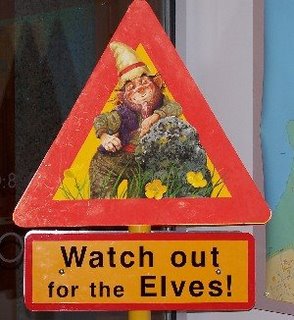
A few days later she desperately needed to put her clothes in the magical washing machine that would make all the gross stains go away, but she was in a rush so she left her pukey clothes on top of the magical machine to be washed once she returned. But when she came back, she found her clothes had disappeared! There was only one possible explanation: ELVES.


Did you know that about 55% of Icelanders believe that, at the very least, it is possible--if not certain--that huldufólk ("hidden people") exist? You are not supposed to throw stones in Iceland because you might hit them (ok, I stole this directly from Wikipedia).

Anyway, bottom line: The fuckin elves took my clothes. But I am holding out that these are good elves and my clothes will be returned clean and neatly folded waiting for me on my bed.

Monday, September 26, 2011

Close Encounters of the Icelandic Kind

I'm choosing to ignore the fact that I haven't posted anything in over a year. But to be fair, this was/is a blog about my travels, and I've thrown myself back across oceans and lakes and streams yet again so it seems as good a time as any to try to get back to this ill-conceived project.

Back to the present.
So, Iceland is a pretty nice country, despite the smell of rotten eggs constantly wafting through the air--seriously, that shit is everywhere. But you get used to it (kind of). So, why the fuck am I here? On a whim I decided to apply to a 2 week Photography & Journalism workcamp in Reykjavik without knowing a goddamned thing about Iceland (including the fact that Reykjavik is the capital city, go figure) with an organization by the name of Worldwide Friends. I know what you're thinking. Yeah, yeah, yeah kum-bay-fucking-ah. Whatever, judge as you like.

Anyway, I don't want to impress you with my photos of the incredible Icelandic landscape I (which you can find here) or disturb you with my stories of reckless abandon (hope you're not reading this, Mom and Dad!). Instead I'd like to briefly highlight some of the experiences I've had related to the overall project of my workcamp.

Thus far our group has been fairly unproductive, but I'm quite happy with some of the discoveries and chance encounters I've had here. While sitting around the workshop area the other day, a guy with a tripod and an expensive looking camera came in with a man from Ghana toting a drum and sporting an Icelandic style wool sweater. I put on some Arcade Fire and it turns out this guy is a filmmaker/photographer from Montreal (Arcade Fire is to Montrealers as Barry White is to women--one note and the clothes is off!). He's here to screen his film about the Icelandic community in Manitoba at the Reykjavik International Film Festival and is currently working on the second part of the project about the different cultures that come to Iceland. He also happens to have some pretty sweet photos of Iceland and other places on his website:
This, of course, is one of my favorites.
Then on Saturday we volunteered with Couch Fest, a film festival from the comfort of your own (or your neighbor's) living room. Anyway, the house I went to help out at was owned by Kitty, woman originally from the UK. Unfortunately I just found this awesome project she's been working on here and I want to know more!

All in all, it's been an interesting experience and I think I've made some good contacts that I can potentially learn a lot from! I honestly just wish I had more time here to explore all the things Reykjavik has to offer, which comes as quite a shock to me. More to come soon! (I hope)