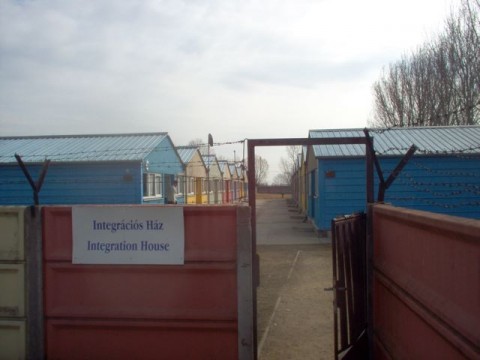
Our house in the camp is pretty nice. I sleep in the living room on a very, very hard bed (I sleep on top of a comforter for a little extra cushion).
 |
| Clearly, I've taken over... |
My main complaint is about the washing/drying appliances:
The washer is a bucket with a wheel for churning the water, the dryer is a bucket with holes that spins really fast to suck out the excess water in the clothes, so to completely dry I put the clothes on top of the radiators and turn the heat up all the way. This whole process takes at least an hour.
 |
| Morning outside my house (the blue-green one) |
A typical day for me starts around 7, when one of us gets up to fetch breakfast. The mornings are peaceful, but a bit eerie: cold and bright, always with the scent of smoke wafting through the air.
 |
| Just another frosty, creepy sunrise |
Breakfast generally consists of a beverage and some salami/bologna/mystery meat with a ton of bread and margarine. One note about the food here: we always have a ton of bread at every meal. Then I shower and eat, preparing for the English lessons at 10. On alternate days I teach intermediate English to one or two men, one of which is very enthusiastic about Canada, and beginners English for women. The classes are split this way because the Afghani women cannot be in the same place with Afghani men who are not their husbands.
 |
| The Red House where we work |
After teaching for an hour or so, lunch is served at 11:30. Laurie and I eat with the other employees in a separate dining room from the minimalist cafeteria for refugees. For many Hungarians, lunch is the big meal of the day, so it always starts with a soup of some kind, followed by a main dish of (very oily) meat accompanied by rice/potatoes/pasta and a side, usually pickles, paprika (which I've found many other countries call bell and hot peppers) or cabbage. Often there is some sort of dessert as well, but lately the camp has been in a questionable financial situation, so dessert is much less frequent and breakfast is also much more bare-bones. While the employees have the option of choosing from menu A or B, we are always served A, so of course, B is always nicer. Menu A is also what the refugees are given. That being said, it's not terrible, just not great. After the meal, we are given our "dinner." Now, as I just noted, the lunch really ain't so bad. What they call dinner is, again, an assload of bread with cans of, well, any rational human being would call it cat food: chicken or beef paste or fish something, as well as juice boxes, what I can only think to call smooshy tubed cheese, and yogurt.
Thus, I usually take away leftovers from lunch, improvise from there, and give the food in the cans to a black cat that comes around every morning. One of my favorite treats is a slice of buttered bread toasted in a pot (we only have a microwave, stove and a pot, no toaster or oven) with some jam on top. I actually crave it sometimes and get really excited just thinking about making it. Yup.
 |
| Our canned cat food collection & some candies... |
 |
| Our well-equipped kitchen |
After lunch, we have free time to nap, read, or use the internet in the NGO (Menedek) building.
We open the Red House again at 1 or 2 for children, who run around screaming and fighting for a few hours. Their favorite things to do are breakdance to the same 3 songs (carry up timbaland, promiscuous girls, and a rap song in Albanian that one of the kids here recorded) and color. Once I made the mistake of letting them play with my phone camera and this photoshoot ensued:

After the demons have cleaned and cleared out (if they haven't already been kicked out for misbehavior) adults come for a small variety of classes—Hungarian, film club, Zumba, stretch—all of which are sparsely attended. Our supervisors here encourage us to start classes we have interests in, but the social workers we work directly with in the house often can't handle more than one activity going on at a time, so our schedule had been pretty restricted and boring until we complained last week. Now we're trying to offer more things, but progress, as always, is slow. A group of teenage guys usually comes to play ping pong and bullshit for a while and lately I’ve been offering some informal English classes for those who can’t make the morning session. By then, my mind is completely spent on having to control the children and attempt to explain minute grammatical mechanics. We close the house at 8 and head home. Sometimes we stop by some of the family’s houses to chat and get treated to some delicious tea, snacks, or baked goods. When I’m feeling up to it, I brave the frigid night air to sit outside the fifth window of the Menedek building to attempt to use the internet at a more convenient time for all you West Hemisphere dwellers. And that’s what I’m doing right now.