Sitting in the worn out seat on the old train, I stared out the window over the sunny and desolate landscape. I had no idea what I was heading into, but was having one of those moments where you see yourself from the outside, knowing how you will look back at your imagined expectations, feeling on the precipice of realizing something you knew was coming all along. These moments are pregnant with anticipation, like a state of suspended animation. I asked my travel companion, Laurie, who I would be working and living with over the next two months, about obscure and basic information on the workings of the refugee camp, my future residence and place of work. I let my imagination wander, knowing full well that these fantasies and assumptions would probably be entirely squashed or transfigured upon my actual arrival.
Once we got off the train, I was most surprised by the city. Debrecen is the second largest city in Hungary after Budapest. Having just spent the weekend in the enormous, cosmopolitan capital, I had high expectations for the city. But driving through what I really hoped was merely the outskirts of town, I was struck by the, well, Third-Worldliness of the place. I had been shocked at how visually similar Budapest was to Buenos Aires, but when Debrecen, with its dusty lots, low-rising autoservice shops, tiny outdoor produce stands, and chalkboard restaurant menus, started to feel like a lazy Latin American town, or Mendoza.
The camp is located at the edge of the city, quite literally:
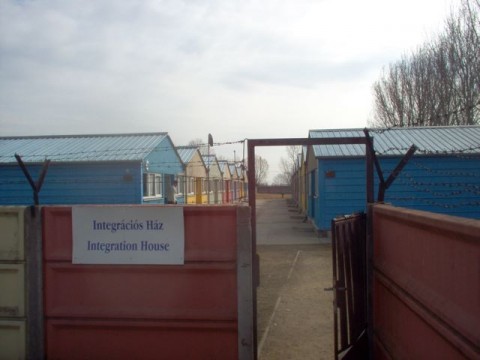
The car pulled up to the large gate connecting a melancholically faded red and yellow two-toned barbed wire fence. The color scheme made me feel like I was about to enter into the most depressing circus in the world, and to some extent, this feeling has remained rather salient throughout my time here. The door of the van slid open, I blinked a few times as I stepped into the golden late afternoon sun, as if the sight of this foreign place was blinding. People were roaming around aimlessly; some watched with disinterested or mild curiosity from afar and others silently drew closer as I, the new arrival, clambered clumsily out of the vehicle. I followed Laurie in the direction of our home. Children ran up to her and grabbed her around the waist, adults hovered nearby to say hello and she greeted them all in what seemed to me like at least ten different languages. She hurriedly explained to me what languages some spoke and I just followed dumbly, stupefied.
Three weeks later, I feel like I have a much better handle on things, though I have accepted that I will probably be living in a state of varying degrees of confusion for the duration of my time here. As Laurie simply put it, "Here in the camp you have more questions than answers."
Once we got off the train, I was most surprised by the city. Debrecen is the second largest city in Hungary after Budapest. Having just spent the weekend in the enormous, cosmopolitan capital, I had high expectations for the city. But driving through what I really hoped was merely the outskirts of town, I was struck by the, well, Third-Worldliness of the place. I had been shocked at how visually similar Budapest was to Buenos Aires, but when Debrecen, with its dusty lots, low-rising autoservice shops, tiny outdoor produce stands, and chalkboard restaurant menus, started to feel like a lazy Latin American town, or Mendoza.
The camp is located at the edge of the city, quite literally:
 |
| The sign before the entrance to the camp |
 |
| As you can see, we are surrounded by absolutely nothing. |
The car pulled up to the large gate connecting a melancholically faded red and yellow two-toned barbed wire fence. The color scheme made me feel like I was about to enter into the most depressing circus in the world, and to some extent, this feeling has remained rather salient throughout my time here. The door of the van slid open, I blinked a few times as I stepped into the golden late afternoon sun, as if the sight of this foreign place was blinding. People were roaming around aimlessly; some watched with disinterested or mild curiosity from afar and others silently drew closer as I, the new arrival, clambered clumsily out of the vehicle. I followed Laurie in the direction of our home. Children ran up to her and grabbed her around the waist, adults hovered nearby to say hello and she greeted them all in what seemed to me like at least ten different languages. She hurriedly explained to me what languages some spoke and I just followed dumbly, stupefied.
Three weeks later, I feel like I have a much better handle on things, though I have accepted that I will probably be living in a state of varying degrees of confusion for the duration of my time here. As Laurie simply put it, "Here in the camp you have more questions than answers."

Love it kell, love it!
ReplyDelete